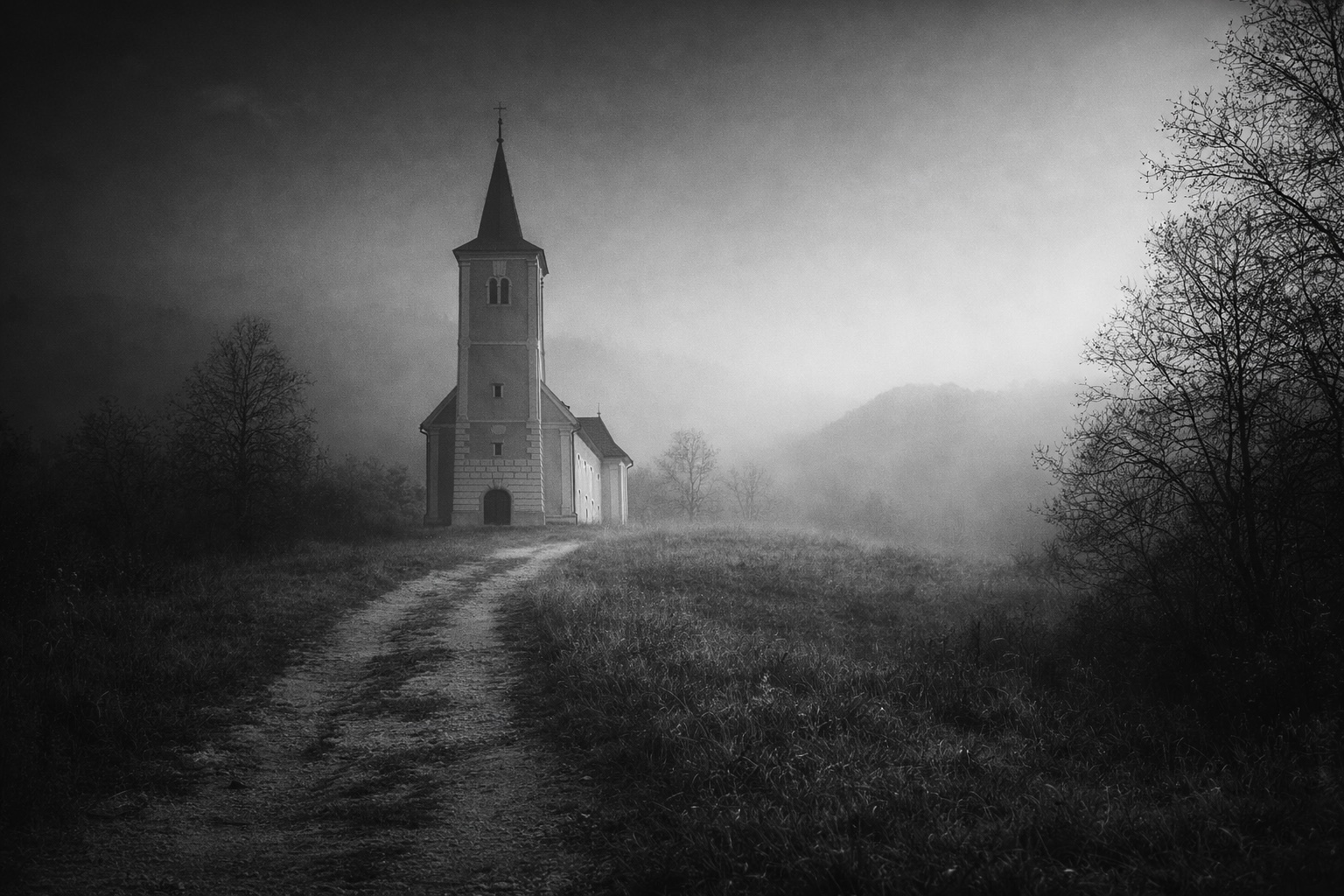
CUSTOMS OF SAINT LUCY'S DAY
In the traditional annual calendar, especially in Croatian Zagorje, certain days went far beyond their strictly liturgical frame.
In the traditional annual calendar, especially in Croatian Zagorje, certain days went far beyond their strictly liturgical frame. One such day was the feast of Saint Lucy. Although it is a church memorial that belongs to the cycle of winter feasts, in everyday folk life Saint Lucy had a much broader meaning. Her day marked not only the memory of one saint, but also the moment when people felt that Christmas was very near, that the year was approaching its end, and that the household, the farm, and one's thoughts were entering that special state of expectation which once had both a deeply practical and a deeply symbolic meaning.
In the rural daily life of Croatian Zagorje there were not many empty days. Every feast had its place, its justification, and its purpose. So it was with Saint Lucy. That day was perceived as a turning point in Advent, a quiet but clear sign that the final part of the season had begun. In many homes, Lucy's day was precisely the point from which Christmas preparations took on a more visible and more solemn form. The household was arranged with greater care, the home economy was prepared for festive days, and daily life itself adopted a calmer, more collected rhythm. Although today such things are often described as "customs," we should remember that they were once an integral part of life, not a folkloric performance set aside for special occasions.
The best-known custom connected with Saint Lucy is certainly the sowing of Christmas wheat. This is one of those elements of traditional culture that has survived almost to the present day, though often in a changed and simplified form. In its original symbolism, wheat was not merely a decoration on the Christmas table. It was a sign of life, renewal, and fertility, but also a reminder of humanity's basic bond with the land. In an agrarian world, which for a long time also prevailed in Zagorje, grain was not an abstract sign of prosperity but a real condition of survival. For that reason, sowing wheat on Saint Lucy's day carried a meaning that was at once practical, symbolic, and almost ritual.
In that small vessel with soil, in that green shoot appearing in the middle of winter, people saw hope that nature had not died, but was quietly preparing for a new cycle. In many homes, people watched how the wheat sprouted, whether it grew dense, whether it stood straight, what color it was, and how strong it looked. This was not only children's observation of something that would look pretty on the table. In that growth they also sensed the fortune of the coming year: the fertility of fields, the health of the household, and peace in the home. However much this may seem today like a remnant of old folk belief, it had its own inner logic in a world that lived closer to land, seasons, and natural uncertainty than we do today.
Saint Lucy was also connected to a wider circle of beliefs that in rural life brought together faith, experience, and the folk image of the world. For a long time people held that the days from Lucy to Christmas were special, and that in some way one could "read" in them what was to come. Weather was observed, each day noted: what the sky looked like, whether there was frost, what kind of fog appeared, whether the wind blew. From such observations people drew predictions for the months ahead. Today we might call this folk meteorology, yet once it was much more than curiosity. It was a need to recognize order in the uncertainty of the world, to sense in natural signs the course of a year on which bread, household economy, and human security depended.
Various other beliefs were also tied to Saint Lucy, especially those touching questions of the future, marriage, and personal fortune. Such customs were generally neither official nor church-regulated, but a part of that older layer of folk culture in which the serious and the playful, the devout and the curious often intertwined. In some regions, girls hoped that on Lucy's day, or on the night after it, they might learn something about a future husband through a dream or a sign. Elsewhere, small forms of fortune telling were practiced, more as part of the winter household atmosphere than as an act with strict and binding force. Yet precisely such examples show how deeply Saint Lucy was inscribed in folk consciousness. She was not merely a date in the calendar, but a day filled with expectation.
Nor should we overlook that in many communities the feast of Saint Lucy carried a powerful symbolism of light. This is especially understandable when we remember that the feast was celebrated in the darkest part of the year, in a time of short days and long nights. People of the old village were far more directly exposed to the rhythm of darkness and light than modern people. A winter evening had its own weight, silence, and confinement. For that reason, it is not surprising that December feasts were filled with motifs of light, warmth, hearth, candle, and gathered household life. In that context, Saint Lucy was not only a patron saint in a church sense, but also a figure who in folk consciousness stood on the threshold of Christmas light.
When speaking about Zagorje, we must keep measure. Not every phenomenon that existed in continental Croatia can automatically be called "typically Zagorje." Yet we should not ignore the fact that Croatian Zagorje for centuries lived within the same cultural and customary circle of northwestern Croatia, sharing with it many forms of devotion, household customs, and folk beliefs. Therefore, Saint Lucy in the Zagorje tradition is not marginal, but an important point in Advent time, one of those days in which the church calendar, the peasant year, and the deeply rooted sense that human life is not separated from the rhythm of nature and inherited communal memory all met.
Today, when such customs are discussed mainly in ethnographic, tourist, or occasional terms, it is easy to lose sight of their original seriousness. Yet that is exactly why remembering them matters. Customs tied to Saint Lucy speak not only of one feast day. They speak of a way of life. They speak of the home as the center of the world, of the land as the source of survival, of time measured not only by the clock but by feasts, of faith that was not abstract but present in daily gestures. They also speak of humanity's need to find, in the darkness of December, a sign of order, hope, and continuity.
For that reason, Saint Lucy in Croatian Zagorje is not merely a memory of an old custom of green wheat on the window sill. She is part of a wider picture of a world in which feast, work, nature, faith, and family life were connected far more tightly than today. In this lies her lasting value: not only as part of a past worth recording, but as a reminder that our elders, in small everyday rituals, preserved what modern life easily forgets: patience, rhythm, symbol, and the meaning of expectation.