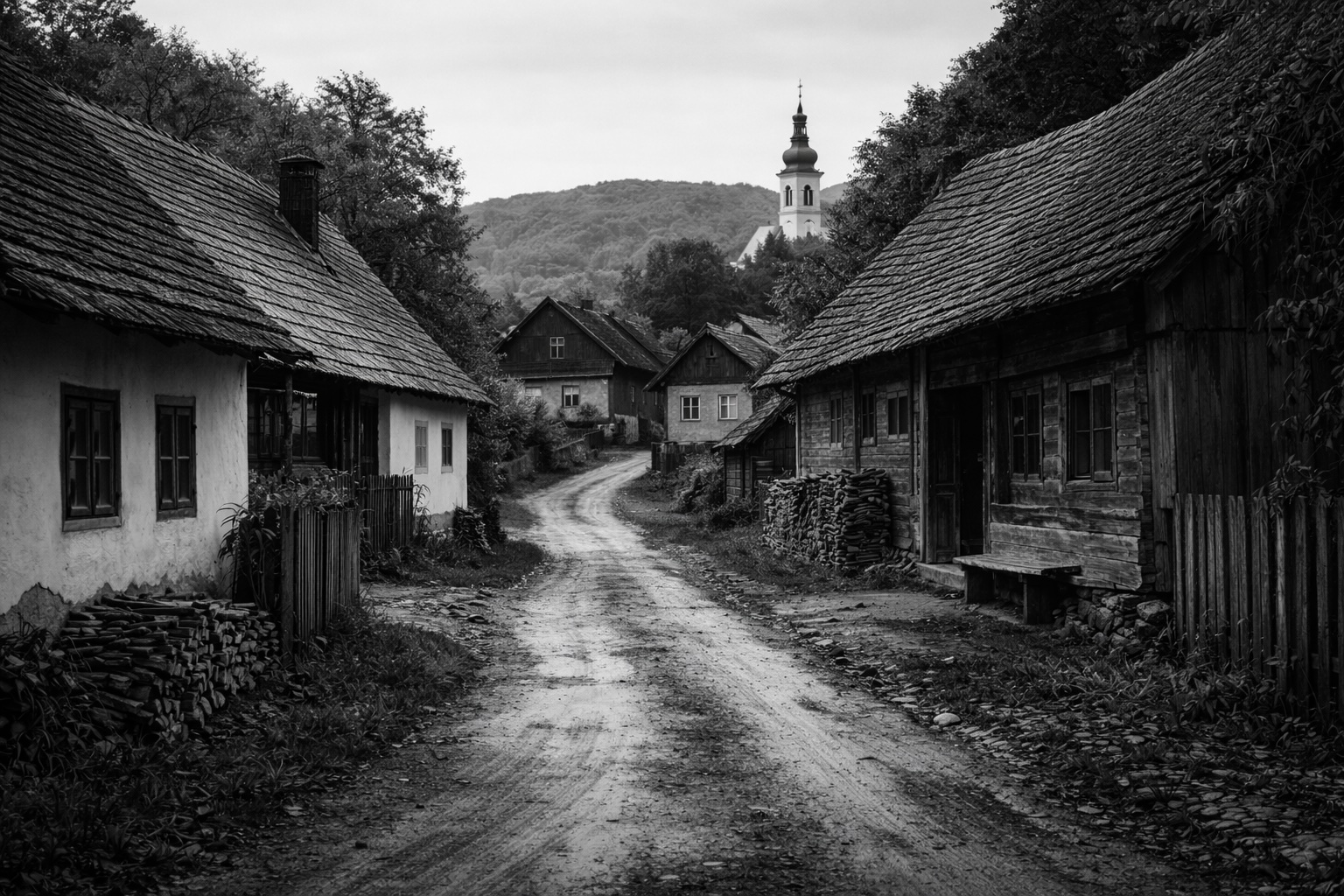
RURAL LIFE IN ZAGORJE IN THE 19TH CENTURY
When we talk about village life in Croatian Zagorje in the 19th century, we must avoid two extremes.
When we talk about village life in Croatian Zagorje in the 19th century, we must avoid two extremes. The first is to portray that life as overly dark, as an uninterrupted sequence of scarcity, hardship, and social subordination. The second is to beautify it into an image of "the good old days," in which, supposedly, everything was simpler, healthier, and more humane. Neither image is faithful to reality. Rural life in Zagorje in the 19th century was hard, but ordered by its own logic. It was modest, but not without order and dignity. It depended on land, weather, and labor, yet was deeply permeated by custom, faith, and community.
At the foundation of everything stood land. In the peasant world of the 19th century, land was not merely property, but the basis of survival. It determined the rhythm of work, the family diet, the possibility of enduring a bad year, and even the position of a household within the community. How much land someone had, what quality it was, whether it lay in one piece or was fragmented into many plots, whether it yielded enough grain, maize, wine, or hay: these were not questions of economic statistics, but of daily life. The peasant lived in direct relation to soil, seasons, and the uncertainty of harvest. That dependence on nature was perhaps the greatest difference between life then and life today.
The house was the center of that world, not only as a building but as a unit of life. In the house, people worked, ate, slept, prayed, were born, fell ill, and died. Bread, tools, seed, and memory were kept there. Within the household, it was clear who did what, who carried which responsibility, who decided, and who carried out decisions. Family life was not conceived as a space of individual freedom in today's sense, but as a community of work and duty. Everyone had a place, from elders to children. The elderly held authority and experience, adults bore the burden of labor, and children were included in household and field work from an early age. Childhood in the village was not a separate stage of life free from obligations, but a gradual entry into the world of work.
The rhythm of the year was the rhythm of agricultural and village life. Spring, summer, autumn, and winter were not only climatic changes, but entirely different states of life. Spring brought land preparation, sowing, the beginning of new hopes, and a new chain of uncertainties. Summer meant the greatest effort, mowing, field labor, safeguarding crops, and making use of every dry and favorable opportunity. Autumn was a time of harvest, gathering produce, and assessing whether the year had been fruitful or hard. Winter had a different rhythm: less field work, but more household tasks, repairs, preparation, inward concentration, and stronger social life within the home. This cycle was not abstract. It entered the body, habit, and mentality of people.
In the 19th century, the village in Zagorje still lived largely within traditional relations, although change was already visible. The century of abolishing feudal obligations, changing property relations, strengthening state administration, and gradual modernizing pressure could not bypass the Zagorje countryside. But these changes did not immediately transform daily life. Old habits, forms of work, and social notions persisted long after the legal framework had changed. The 19th-century peasant often lived between old and new: freed from some former burdens, yet still tied to modest land, weak transport links, limited economic opportunities, and the strong influence of the local community.
Diet was simple and determined by household means. People did not eat what they wished, but what the house had and what the year yielded. Maize, grains, potatoes, cabbage, beans, milk, cheese, lard, occasional meat: this was a food world with little luxury. The festive table differed from the daily one precisely because daily life was not abundant. Food was directly connected to work and survival. It was not a matter of choice, but necessity. Still, even in that modesty there was order, a sense of measure, and respect for bread as something not to be wasted.
Clothing also reflected the social reality of the village. It had to be practical, durable, and suited to labor. Festive clothing existed for holy days, church, weddings, and major occasions, but everyday life unfolded in clothes subordinate to function. In such a world, appearance was not used for self-display in the way modern society knows it, yet there was strong awareness of neatness, propriety, and social impression. How someone came to Mass, how the house looked, how the yard was arranged, how children were raised: all of this spoke about household order and family reputation.
Religion was deeply woven into village life. This does not mean every form of piety was strictly theological, but it does mean the church calendar structured time, custom, and the sense of the world. Feasts, processions, observances, fasting, vows, and folk devotion were integral parts of daily life. In Zagorje, as elsewhere in continental Croatia, religious life was not separate from work and the yearly cycle, but intertwined with them. Feasts did not merely interrupt labor; they gave it meaningful rhythm. People did not live only by grain and vineyards, but also by the calendar of saints, Sunday Mass, and the sense that time and life were subject to a higher order.
The rural community was strong, but not always gentle. People lived close to one another; everyone knew who was who, who had what, how each household lived, and what reputation it held. Such closeness meant mutual help, especially in labor, hardship, illness, or building, but also social supervision. The individual was not anonymous; his life was visible to the community. In that, the village had both its safety and its strictness. Reputation was gained slowly and lost quickly. Word, diligence, honesty, household order, and bearing mattered greatly. The village remembered both good and bad.
The position of women in that world must also be mentioned. Woman was not merely an accompanying figure of domestic life, but one of its main supporting pillars. Alongside household management, children, food preparation, and home maintenance, women took part in many tasks tied to the economy of the household. The burden of their labor was heavy, and their social space often limited. Yet without their work, neither the house nor the daily order of village life could be maintained. The rural world of the 19th century was deeply patriarchal, but in practice it depended greatly on women's strength, endurance, and ability.
Rural life in Zagorje in the 19th century was not static. Changes came slowly: different forms of administration, greater movement of people, new economic opportunities, schooling, stronger links with towns, transport development, and shifts in agrarian relations. But these changes did not immediately erase the old structure of life. For a long time, people lived in a world where tradition was stronger than novelty. Change arrived slowly, sometimes almost invisibly. That is why the 19th century is so important: it shows how the old village still held to its foundations, yet was already entering a period from which a different society would emerge.
When we look at that world from a historical distance today, we should neither idealize nor underestimate it. It contained much hardship, dependency, and modesty, but also order, perseverance, and inner strength. People did not live easily, but they lived within clear frameworks of meaning. It was known when one worked, when one celebrated, when one sowed, when one harvested, when one went to church, when one sat at the table, and how the household was maintained. This does not mean that world was better than today's, but it does mean it was more coherent in its rhythm.
In this lies the importance of historically understanding rural life. It is not merely a collection of old objects, costumes, houses, and customs. It is a way in which society was organized around land, labor, family, and community. Croatian Zagorje in the 19th century was shaped not only through political events and administrative reforms, but through the quiet daily life of its villages. If we wish to understand the history of that region, we must also understand the person who rose early, cultivated his land, kept household order, lived modestly, believed deeply, and year after year repeated the same effort from which communal life was formed.
In that quiet, persistent, and often invisible labor lies the true historical weight of the village. History was not made only by great people and great events. It was also made by those who left no written records of their own, yet left traces in the landscape, in the way land was cultivated, in customs, in village layout, in oral tradition, and in the very structure of everyday life. Rural life in Zagorje in the 19th century therefore deserves to be viewed not from above, but with understanding. It contains a history of work, patience, and endurance, and that is, in the end, one of the most important histories there is.