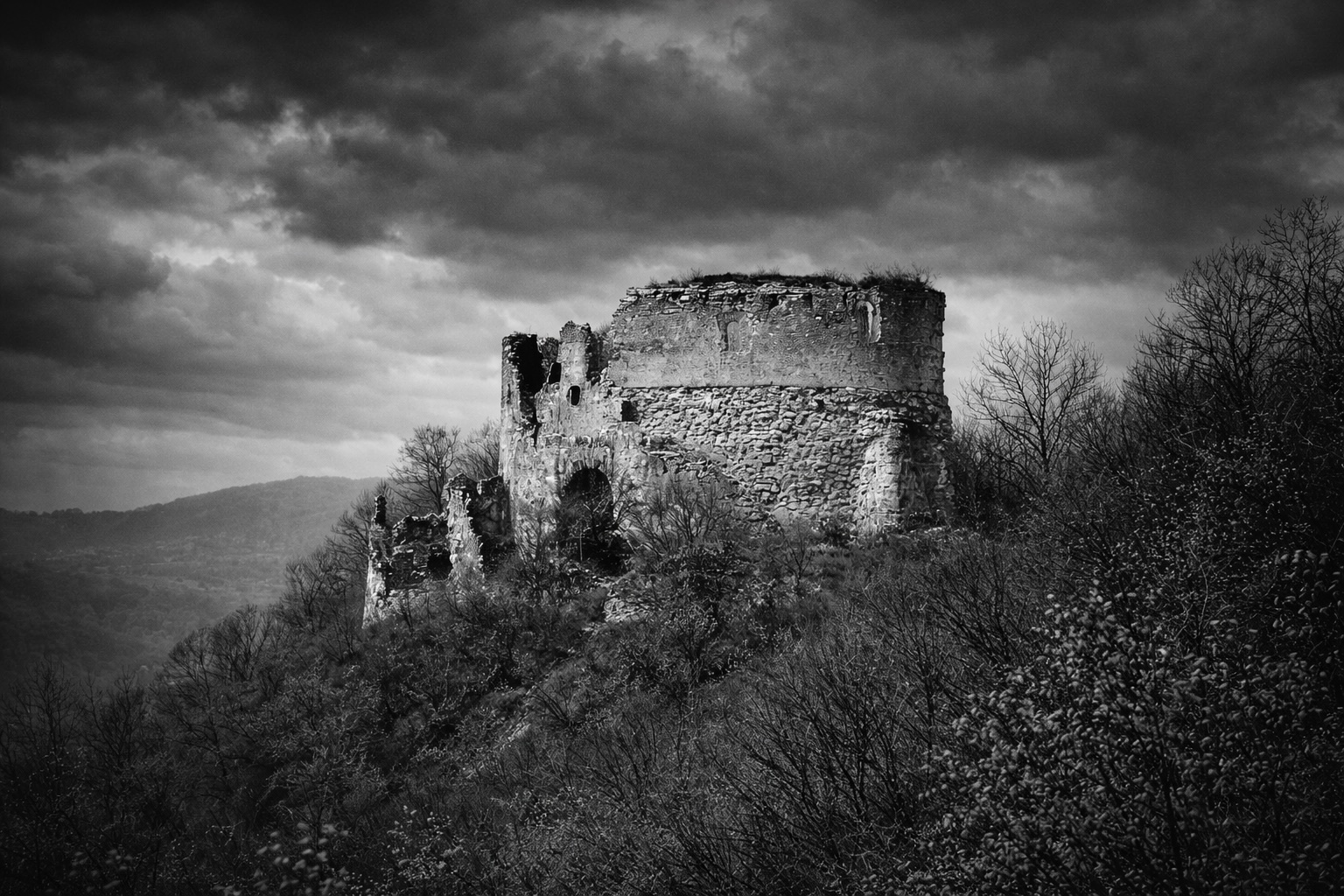
SECRETS OF CESARGRAD
When Cesargrad is mentioned in Croatian Zagorje, it is not only one fortress that is being mentioned.
When Cesargrad is mentioned in Croatian Zagorje, it is not only one fortress that is being mentioned. A whole landscape is being invoked, a historical layer, and a kind of quiet presence of the past that has not disappeared even today. Ruins of old towns always carry something that goes beyond the structure itself. They are no longer a fortress in the full sense of the word, nor merely stone without meaning. They are traces of power, signs of an old order, witnesses of fear, safety, conflict, and of the human need to subject space to order. So it is with Cesargrad. It stands not only as a remnant of one era, but as a reminder of an entire world that once existed around it.
Today, when an observer approaches such ruins, it is easy to surrender to the first impression: picturesque beauty. Crumbling walls on a rise, forest, stone, silence, and a far-reaching view almost by themselves invite a romantic image of the past. But for a historian, that first impression is not enough. Behind every old stronghold we must try to see what is no longer visible to the eye: the people who passed through it, the authority that held it, the military need for which it was built, the economic logic that sustained it, and the social order that gave it meaning. An old fortification was not a backdrop. It was an instrument of control, defense, authority, and organization of life in the territory that belonged to it.
This is precisely what makes Cesargrad especially interesting. Its history cannot be reduced only to the question of when it was built and who held it at a given moment. It belongs to that chain of medieval and early modern strongholds whose role in space was much broader than pure military defense. Such towns were also administrative centers, symbols of economic power, and points from which land, people, revenues, and obligations were managed. Their existence was closely tied to the way feudal order shaped daily life. They were not only places from which one defended; they were places from which one ruled.
That is why the secret of Cesargrad is not primarily that it is old and ruined today, but that it compels us to think of space as a historically shaped landscape. Every elevation on which an old fortification stands speaks of the need for supervision. Every wall speaks of insecurity. Every tower or defensive line points to threat, but also to authority. Where today we see stone overgrown with greenery, there once existed a clear hierarchy: lord and subject, command and execution, safety within walls and danger beyond them. In such a world, a fortress was not merely a building. It was an ordered response to the disorder of time.
Yet old strongholds rarely remain only within the sphere of pure historical fact. Over time, legends, assumptions, and stories gather around them. So it is with Cesargrad. Among people, especially where a ruin has stood above a region for centuries, there is always a need to fill it with story. That is nothing unusual. Where the archive is silent, or where historical memory has been interrupted, tradition takes over the role of interpreter. People speak of hidden passages, forgotten lords, buried treasure, injustices and misfortunes, women and soldiers, night and fire, of something that existed and then vanished. Such stories are not historical proof in themselves, but they are part of the historical consciousness of a region.
This is one of the greater values of places like this. Cesargrad belongs not only to history in the narrower archival sense, but also to the history of memory. There is a history of fact, and there is a history of the impression a fact leaves in a community. One without the other is not enough for full understanding. A historian must not mistake tradition for a source, but should equally not ignore the fact that tradition speaks of how a community experienced its own past. A ruin that has stood above a region for centuries does not remain mute. It enters people's conversations, their childhood, the view from a yard, and the feeling that in that space there is something older than the present.
Cesargrad also belongs to those places where it becomes very clear that history is not only a sequence of political events, but also a history of space. The fortress was not separate from road, village, land, and the people living below it. Everything that happened around the old town entered into its meaning. The peasant working the land, the traveler passing through, the guard on watch, the lord issuing orders: all belonged to the same historical scene, though not from the same position. Today we can no longer see these people, but we can understand the structure of the world in which they lived. That is the task of historical interpretation: not only to describe a ruin, but to recover the relations that once gave it life.
Here, measure is necessary. Old fortifications easily seduce us in two directions. One is excessive romanticization, in which every ruin becomes an almost poetic image of lost nobility. The other is dry factography, in which a fortress becomes only a list of dates, owners, and architectural features. Neither is enough. The true value of such places lies between those two approaches. We need to preserve a sense of spatial atmosphere, but remain faithful to historical discipline. We should know that a ruin may be beautiful to the eye, while its history was not necessarily beautiful to those who lived in its shadow.
If people speak today of the "secrets" of Cesargrad, those secrets are not primarily sensational. They do not lie in hidden treasure or mere legend. Its greatest secret lies precisely in what we no longer see, and yet still sense: in invisible traces of lives that once unfolded there. Who walked through that space? What decisions were made there? What was the view from the ramparts in times of danger? What was the silence after conflict? How many human destinies remained tied to walls that can no longer speak? These questions remain open not because there are no answers at all, but because every historical site always preserves a surplus of meaning beyond what can be fully reconstructed.
In this lies the lasting value of Cesargrad. It teaches us that the past is not dead matter, but layered presence. It teaches us that landscape is not empty, but filled with traces of power, labor, fear, and memory. It also teaches us that a ruin is not only a remnant of collapse, but one of the most persuasive forms of endurance. Everything that was once ordered, solid, and purpose-driven becomes, over time, the silence of stone. But that silence is not without content. On the contrary, it may be the most convincing form of historical testimony.
For that reason, Cesargrad should not be viewed only as a monument of the past, but as a meeting place between time that has vanished and time that tries to understand it. Whoever approaches it only as an excursion destination will see a ruin. Whoever approaches it with historical sensibility will see far more: an elevation from which space was once governed, an order that has disappeared, a memory that has not entirely fallen silent, and a lasting reminder that every landscape around us is older, deeper, and more complex than it appears at first glance.